

Beyond mere optics: revenue-critical metrics for vehicle occupancy detection
4 min. reading time
By Javier Rojo Fernández, ITS & Tolling Director, Indra Group
As managed lanes and High Occupancy Vehicle (HOV) policies become a growing part of modern traffic management, the need for high-accuracy Vehicle Occupancy Detection (VOD) systems has escalated significantly. The effectiveness of these systems directly impacts both revenue generation and public trust. Indra Group USA has pioneered a highly mature, multi-angle artificial vision-based VOD system, which is currently operational across 40 toll zones and 59 lanes in the United States as well as internationally.
However, the market has recently seen the emergence of unproven single-angle systems that use misleading statistical practices to inflate performance claims and hide technological shortcomings. This article outlines the technological imperatives for an effective VOD system and establishes a framework for disciplined, revenue-impacting performance measurements.
What are the advantages of a multi-angle detection system?
A fundamental limitation of single-angle or sidefire-only VOD systems is their physical inability to reliably detect vehicles and occupants across multiple lanes due to vision blockage from adjacent vehicles or shoulders. These legacy systems collect fewer usable images and eliminate a large number of HOV-eligible vehicles from occupancy analysis.
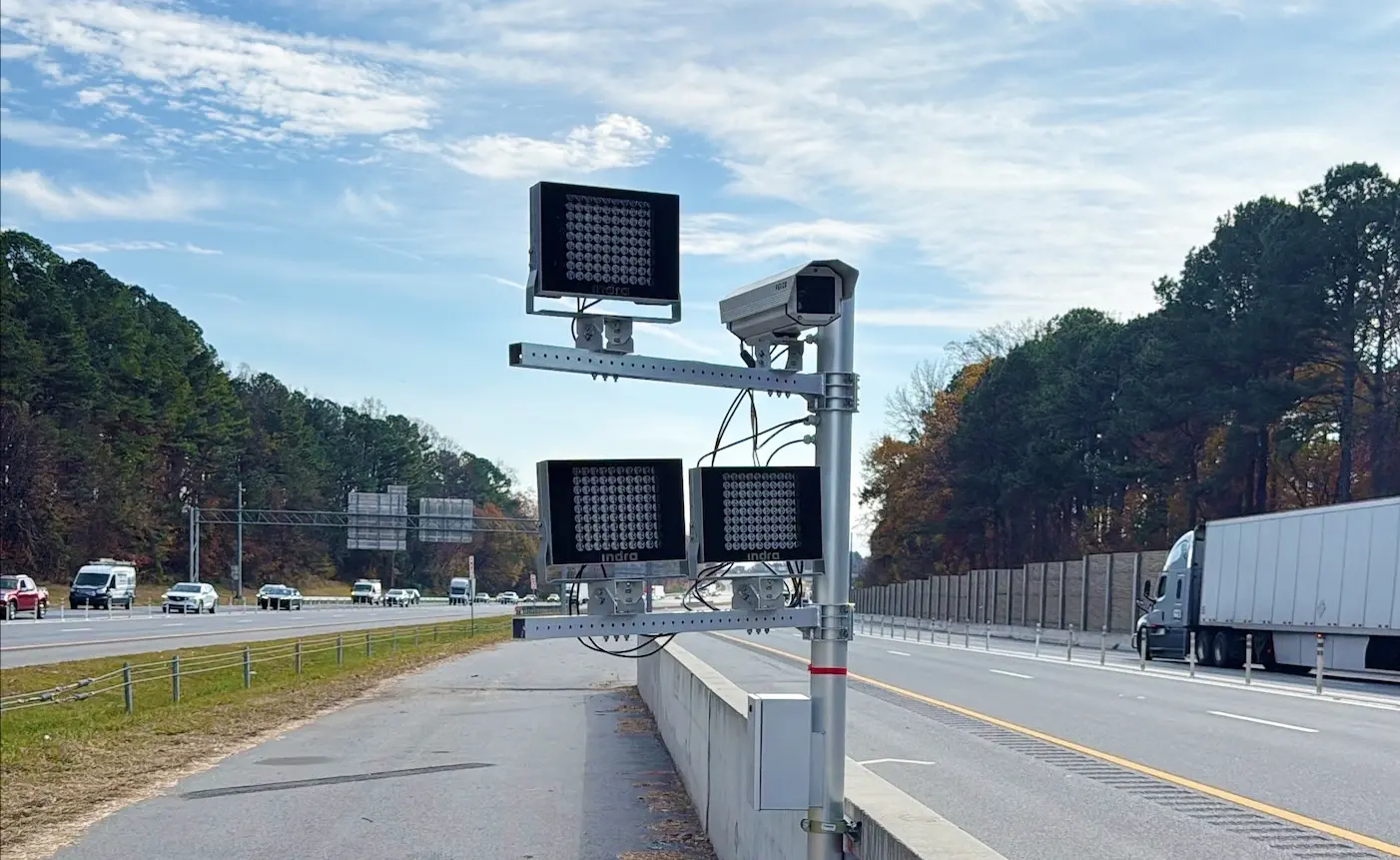
In contrast, a multi-angle approach captures both lateral and front-view high-resolution images of vehicle interiors. By correlating data from multiple angles, this multi-lane coverage successfully offsets potential blockage, yielding a larger dataset of usable images and reliably counting occupants regardless of lane position.
Furthermore, VOD architecture must be resilient to variable environmental factors. Indra’s advanced camera polarization, infrared technologies, and custom-designed wavelength illuminators are critical to penetrate tinted glass and window glare across all lighting and weather conditions. The integration of these features with a core AI analytics engine — trained on production data from 32 operational sites over five years — delivers unprecedented accuracy. A 2024 operational audit of this system underscored its reliability: only six occupancy miscounts out of a sample of 20,000 automatically flagged HOV violations.
Defining true revenue-impacting metrics
To evaluate VOD systems, transportation authorities must demand transparent Key Performance Indicators (KPIs) rather than metrics optimized for marketing. To begin, baseline calculations must accurately identify Vehicle Detection Accuracy and HOV-Eligible Vehicle Detection Accuracy to ensure performance is measured against a holistic, unmodified quantity of vehicles.
Additional metrics, such as Vehicle Image Acquisition Failure and Operator Clear View Image Failure, are vital to operational transparency. These calculate the exact proportion of instances where a vehicle is present but the system fails to generate a clear, reviewable image, thus validating the VOD system's core image capture capability. Furthermore, closely monitoring the Tinted Windows Exclusion Rate ensures that drivers with tinted windows cannot evade detection.
The ultimate measure of enforcement is HOV-3+ Detection Accuracy, which relies on identifying two distinct failure variables that carry significant cost implications. False Negatives (identifying a cheating single-occupant vehicle as a legitimate HOV) directly cause revenue loss by failing to toll violators. Conversely, False Positives (identifying a legitimate HOV as a cheater) mischarge compliant drivers, resulting in customer service burdens and erosion of public trust.
Statistical manipulation in single-angle evaluations
Competitors who deploy single-angle systems will frequently manipulate statistical evaluations to hide their inherent limitations. An analysis of publicly available performance data reveals systemic practices designed to artificially inflate accuracy metrics:
- Post-hoc Ground Truth Pruning: Difficult transactions, such as fully occluded vehicles, are silently removed through arbitrary filters or categorized as "NaN" or "no window." Discarding these unreadable transactions prior to calculation hides the exact failure modes that lead to revenue leakage.
- Denominator Manipulation: In the analysis, the False Positive rate must be calculated by dividing the number of incorrectly flagged single-occupancy vehicles by the total number of transactions flagged as potential cheaters. Instead, single-angle providers often deflate their False Positive rate by dividing incorrectly flagged vehicles by the total number of all vehicles in a sample, using an artificially large and irrelevant denominator to lower the error rate.
- Overly Strict Matching and Parameter Tuning: Competitors frequently use matching algorithms that discard near-matches, which results in undercounting difficult edge cases. Additionally, threshold knobs (interactive/tunable confidence and quality thresholds) steer outcomes toward favorable results.
Conclusion: A framework for meaningful VOD performance measurement
To ensure data integrity and facilitate equitable comparisons, VOD pilot programs must adopt disciplined evaluation standards. Indra recommends implementing predefined, 24/7 sampling periods or pre-agreed time windows to prevent the artificial hiding of bad performance periods.
Sampling must account for diverse operational conditions, including day/night cycles, heavy precipitation, and varying vehicle types. Most important, ground-truth pruning must be strictly forbidden; operators must maintain a full exclusion ledger and require all unknown, low-quality, and unmatched images to be explicitly included in the denominators of performance calculations.
By adopting these rigorous benchmarks, operators can accurately validate true occupancy detection capabilities and successfully safeguard their managed lanes.